

Homework Tips: Note-taking That Actually Helps Learning


Why Note-Taking Feels Overwhelming for Some Students
"She sits there with her pen ready, but by the time she writes down the first thing the teacher said, they've moved on to three other points..."
Note-taking can feel like an impossible juggling act for many students, especially those with slow processing speed or auditory processing challenges. These students often experience a frustrating delay between hearing information and being able to process and write it down. By the time they've captured one idea, the teacher has moved on, leaving them feeling perpetually behind.
Students with processing differences may struggle with:
Listening and writing simultaneously (divided attention is cognitively demanding)
Identifying what's important while information is coming at them quickly
Organizing information in real-time without time to think and plan
Keeping up with the pace of typical classroom instruction
But here's why note-taking is worth the effort: it transforms passive listening into active learning.
Why Note-Taking Matters More Than You Think
Research consistently shows that students who take notes—even imperfect ones—learn and remember more than those who just listen.
Note-taking forces the brain to:
Actively process information rather than letting it wash over them
Make connections between new concepts and prior knowledge
Organize ideas in ways that make sense to them
Create a study resource for later review and test preparation
The act of note-taking itself is a form of learning, not just preparation for learning later.
The Handwritten vs. Typed Debate
While laptops might seem like the obvious solution for students who struggle with note-taking speed, research suggests handwritten notes often lead to better learning outcomes.
Key research findings:
Mueller and Oppenheimer (2014) found that students who took handwritten notes performed better on conceptual questions than those who typed
Handwritten notes encourage processing: The slower pace of writing forces students to be more selective about what they record, leading to better comprehension
Typed notes often become transcription: Students can type fast enough to capture everything verbatim, but this doesn't require the same level of processing
The TLDR: While typing might help students capture more information, handwriting typically leads to better understanding and retention. For students with processing challenges, the key is finding strategies that make handwritten note-taking more manageable.
Strategy 1: The Split-Page Method
Best for: Beginning note-takers or students who feel overwhelmed by traditional note-taking
Why this works: This method separates the cognitive load of listening and organizing by creating designated spaces for different types of information.

The procedure:
Divide your paper into two columns (draw a line down the middle)
Left side: Main ideas and key points (teacher's words, textbook headings)
Right side: Your thoughts, questions, and connections (personal reactions, clarifying questions)
During class: Focus mainly on the left side—capture key points without worrying about perfect organization
After class: Use the right side to add your own thoughts, questions that arose, or connections to other material
Why it's powerful: This method acknowledges that note-taking happens in two phases—capture and processing. Students don't have to do all the thinking in real-time, reducing cognitive overload during instruction.
Strategy 2: The Cornell Note-Taking System
Best for: Students ready for more structure who want to improve their study habits
Why this works: This research-backed system creates built-in review and study tools, making notes more useful for long-term learning.

The procedure:
Set up your paper:
Draw a line 2.5 inches from the left margin (cue column)
Draw a line 2 inches from the bottom (summary section)
The remaining space is your note-taking area
During class: Take notes only in the main note-taking section
After class (within 24 hours):
Write key terms, questions, or main ideas in the cue column
Summarize the main points in 2-3 sentences at the bottom
For studying: Cover the notes, look at the cues, and try to recall the information
Why it's powerful: The Cornell system builds in the review and reflection that many students skip. The cue column creates instant flashcards, and the summary forces students to identify the most important concepts—both crucial for long-term retention.
Strategy 3: Concept Mapping for Complex Topics
Best for: Visual learners and students tackling subjects with lots of interconnected concepts
Why this works: Some information doesn't fit well into linear note formats. Concept maps help students see relationships and connections that might be missed in traditional outline-style notes.

The procedure:
Start with the main topic in the center of your paper (draw a circle around it)
Add major subtopics as branches from the center
Connect related ideas with lines and labels explaining the relationship
Use different colors for different categories or types of information
Add details as smaller branches off the main concepts
When to use it:
Science topics (ecosystem relationships, chemical processes)
History (causes and effects of events)
Literature (character relationships, themes)
Any subject where understanding connections is crucial
Why it's powerful: This method mirrors how our brains actually organize information—in networks rather than lists. Students often discover connections they wouldn't notice in linear notes, leading to deeper understanding.
Strategy 4: The Outline Plus Method
Best for: Advanced students who need to capture detailed information efficiently
Why this works: This hybrid approach combines the structure of traditional outlining with space for personal processing and questions.
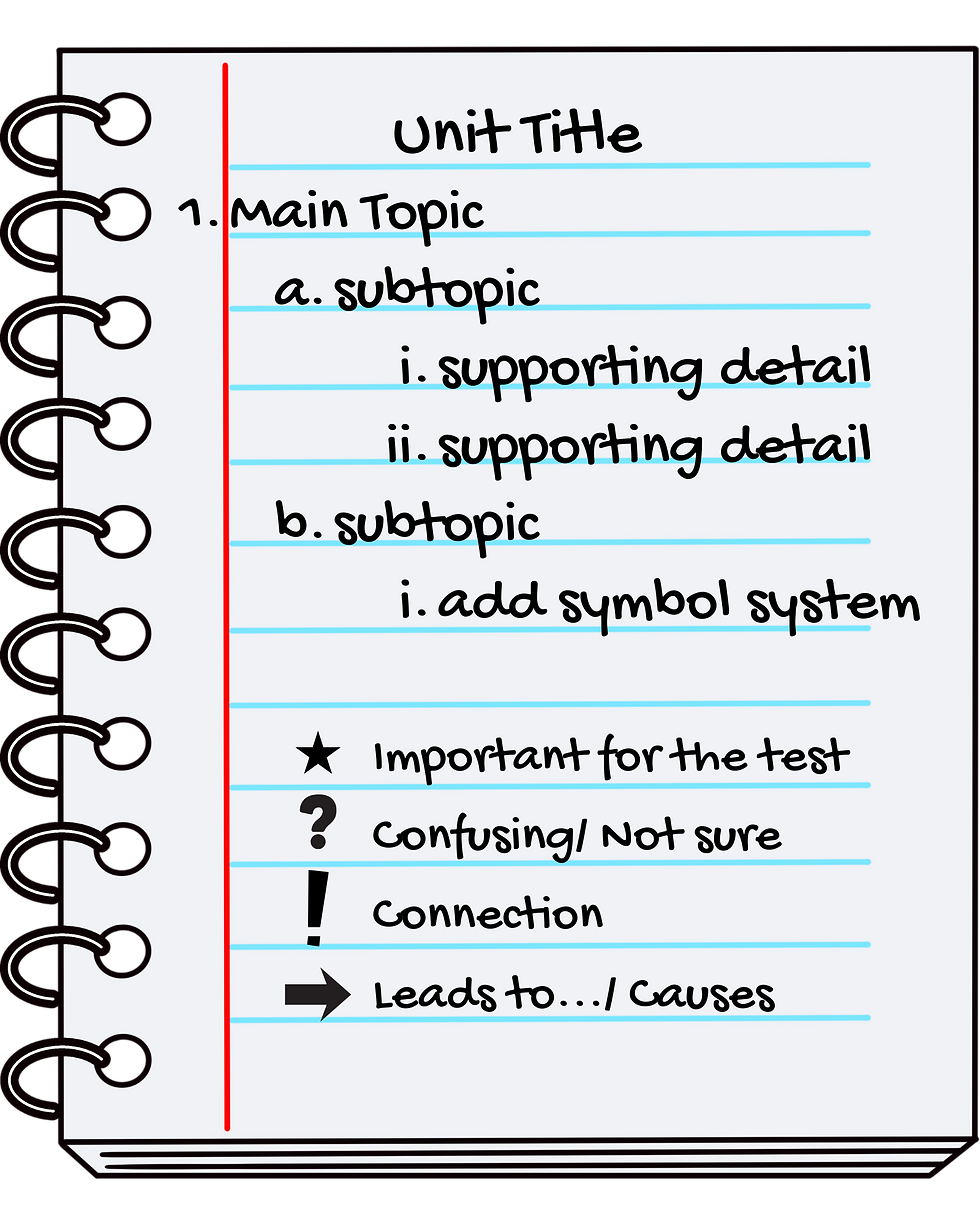
The procedure:
Use traditional outline format for main content
Add a symbol system
Leave white space for adding information later
Use abbreviations consistently:
w/ = with, b/c = because, gov't = government
Review within 24 hours and add any missing connections or clarifications
Why it's powerful: This method allows students to capture comprehensive information while still engaging in active processing through the symbol system. The structured format makes review easier, while the symbols help prioritize information for studying.
Strategy 5: The Question-Driven Method
Best for: Mature students who want to develop critical thinking skills alongside note-taking
Why this works: This method transforms students from passive recorders to active questioners, promoting deeper engagement with material.
The procedure:
Before class: Review previous notes or readings and write 2-3 questions you hope will be answered
During class:
Write these pre-questions at the top of your notes
Take notes in a Q&A format when possible
Generate new questions as they occur to you
After class:
Identify which questions were answered and which weren't
Write new questions that emerged from the lesson
Research unanswered questions or save them to ask the teacher
Why it's powerful: This method develops the questioning mindset that characterizes expert learners. Students become active participants in their learning rather than passive recipients of information.

Quick Tips for All Note-Taking Methods
Before you start:
Date and title every set of notes
Review previous notes for 2-3 minutes to activate background knowledge
Have your materials ready (don't waste mental energy searching for pens)
During note-taking:
Focus on capturing ideas, not perfect spelling or grammar
Use bullet points rather than complete sentences when possible
Leave space between topics for later additions
After class:
Review notes within 24 hours while memory is fresh
Add clarifying information or questions
Connect new information to what you already know
Your Action Plan
Choose ONE note-taking method to focus on this week:
If your child is new to note-taking or feeling overwhelmed: Start with Strategy 1 (Split-Page Method)
If they're ready for more structure: Try Strategy 2 (Cornell Notes)
If they're visual learners dealing with complex topics: Experiment with Strategy 3 (Concept Mapping)
If they need to capture detailed information: Practice Strategy 4 (Outline Plus Method)
If they're advanced students ready for critical thinking: Implement Strategy 5 (Question-Driven Method)
💡 Remember: It takes time to develop any new note-taking system. Encourage your child to stick with their chosen method for at least two weeks before evaluating its effectiveness.
Ready to End Homework Battles for Good?

Note-taking challenges often reflect underlying processing speed, auditory processing, or executive function differences that need targeted support. If your child continues to struggle with note-taking despite trying different methods, the issue may be with the underlying skills, not the strategy.
I work one-on-one with families to identify specific processing challenges and develop personalized learning approaches that work with your child's unique brain wiring. Through my intake consultation, we'll uncover why traditional methods aren't working and create strategies tailored to your child's learning profile.
Don't let note-taking difficulties limit your child's academic success. Schedule your intake consultation today and discover how the right support can turn struggling into thriving in school and beyond.


